Pets and the holidays: the two hidden forces slowing beachside rental leasing this season
We pulled every closed lease in Cape Canaveral and Cocoa Beach from the past year. Winter timing and a no pets rule each add weeks of vacancy, and neither buys a higher rent.
Don HarkinsPublished 8 min read
Key takeaways
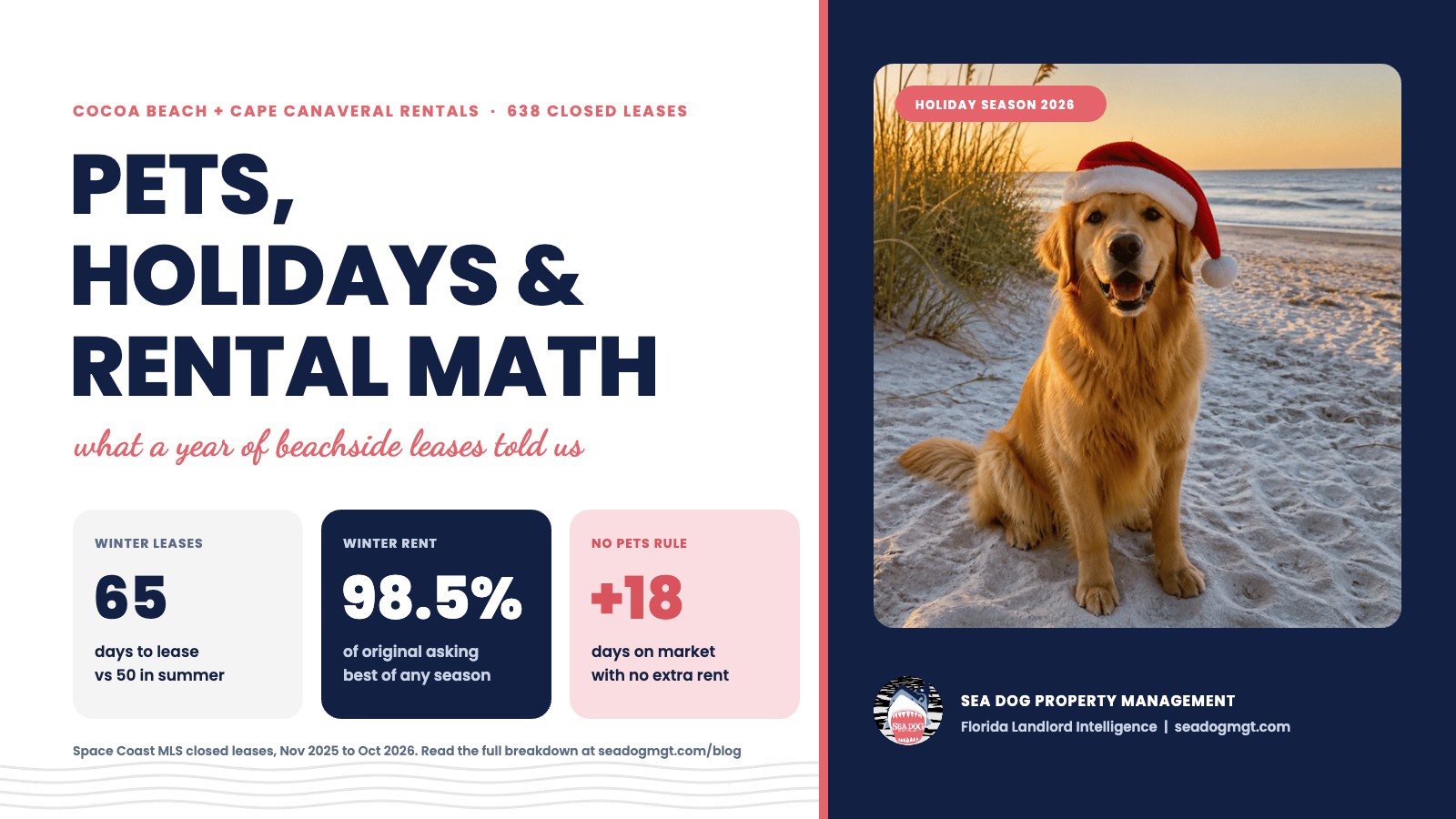
- Leases signed December through February took a median of 65 days, against 50 in summer and 34 in April, the fastest month
- Winter tenants paid closest to full asking all year at 98.5%, so a home vacant in November or December should be priced right and held, not cut
- March was the softest month on price at 93.5% of original asking, so a spring vacancy should expect to negotiate
- A no pets rule added about 18 days of vacancy, roughly $1,260 on a $2,100 rental, and 35% of no pets homes sat more than 90 days
- Bedroom for bedroom, no pets homes asked no more per square foot than pet friendly homes, so the ban protects a price advantage that does not exist
In this article
Two things slow a beachside rental down more than most owners expect, and neither shows up on the listing. The first is the calendar: leases signed from December through February in Cape Canaveral and Cocoa Beach took a median of 65 days to come together, against 50 days in summer. The second is a single line in the listing, no pets, which added about 18 days of vacancy and did not buy a higher rent. We pulled all 638 residential leases that closed in ZIP codes 32920 and 32931 between November 2025 and October 2026 from the Space Coast MLS to measure both.
Why do holiday season leases take longer on the Space Coast?
The people who move in winter are a different crowd. Families with children move in summer so school is not interrupted. Space Force and contractor transfers cluster around the fiscal and school calendars. Snowbirds arrive in late fall, but many of them rent furnished and short term, and they are picky about dates. What is left between Thanksgiving and Valentine's Day is a thinner pool of renters who are also distracted by travel, guests and year-end spending. Fewer showings per week means more weeks to reach the one renter who applies.
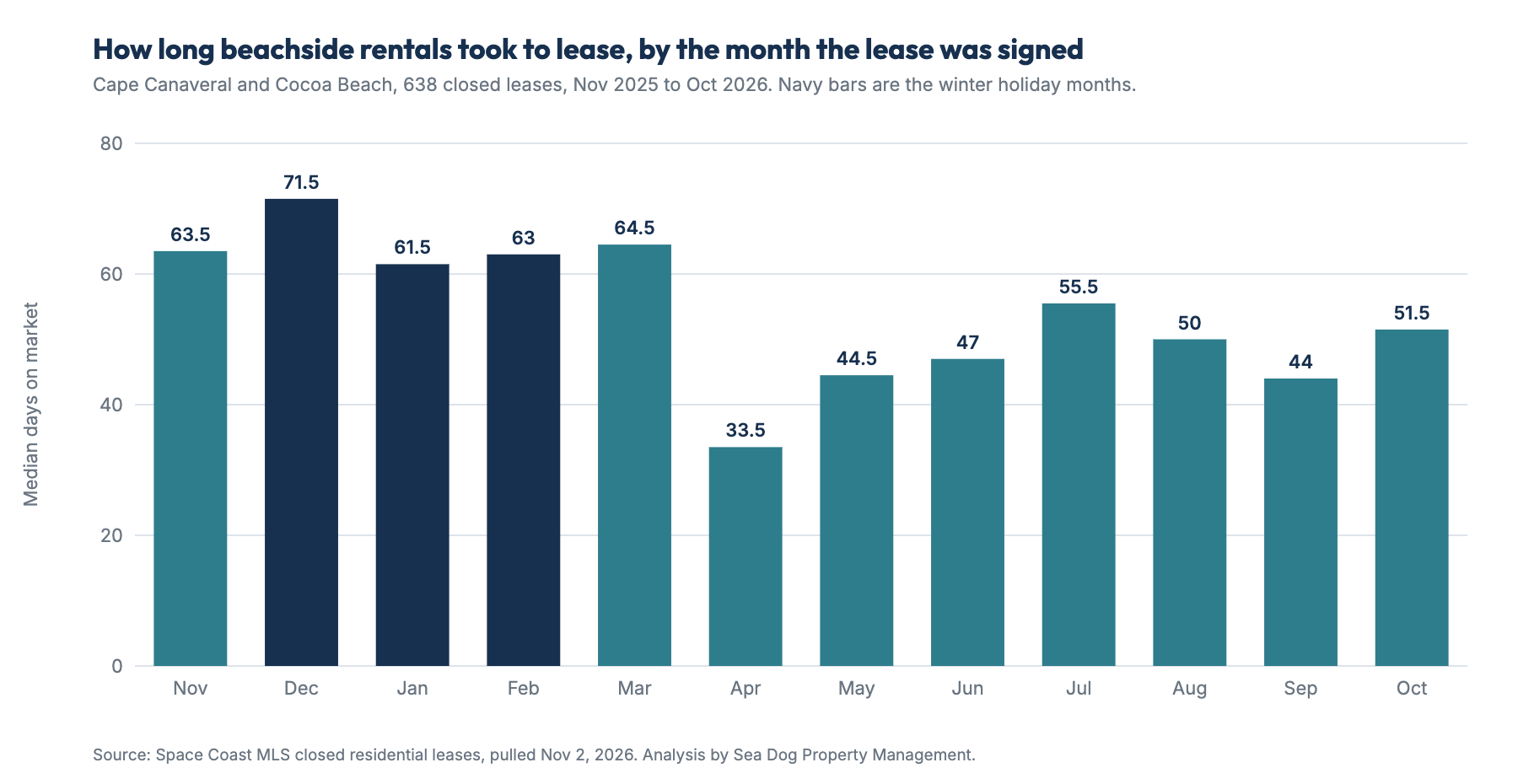
The data bears that out. Here is the median number of days a beachside rental sat before its lease was signed, grouped by the month the lease was signed.
| Season | Leases | Median days to lease | Average days to lease |
|---|---|---|---|
| Winter (Dec to Feb) | 147 | 65 | 88 |
| Spring (Mar to May) | 169 | 51 | 77 |
| Summer (Jun to Aug) | 189 | 50 | 80 |
| Fall (Sep to Nov) | 107 | 56 | 78 |
December was the slowest month of the year at a 71 day median. April was the fastest at 34, and the spring surge was strong enough that more than 60% of April leases closed at full asking. Over half of the homes that leased in winter had been on the market more than 60 days.
Our post on how long a rental should sit vacant uses three to five weeks as the benchmark for a well priced home. On the beachside in winter, the honest benchmark is closer to eight to ten weeks. That matters when you are deciding whether a slow December is a pricing problem or just December.
Does a winter tenant pay less or more?
Here is the part that surprised us. Winter is the slow season for showings, but it is the strong season for price. Leases signed from December through February closed at an average of 98.5% of the original asking rent. Spring and summer leases averaged about 95.4%. March was the softest month of the year, with tenants paying an average of 93.5% of what the owner first asked.
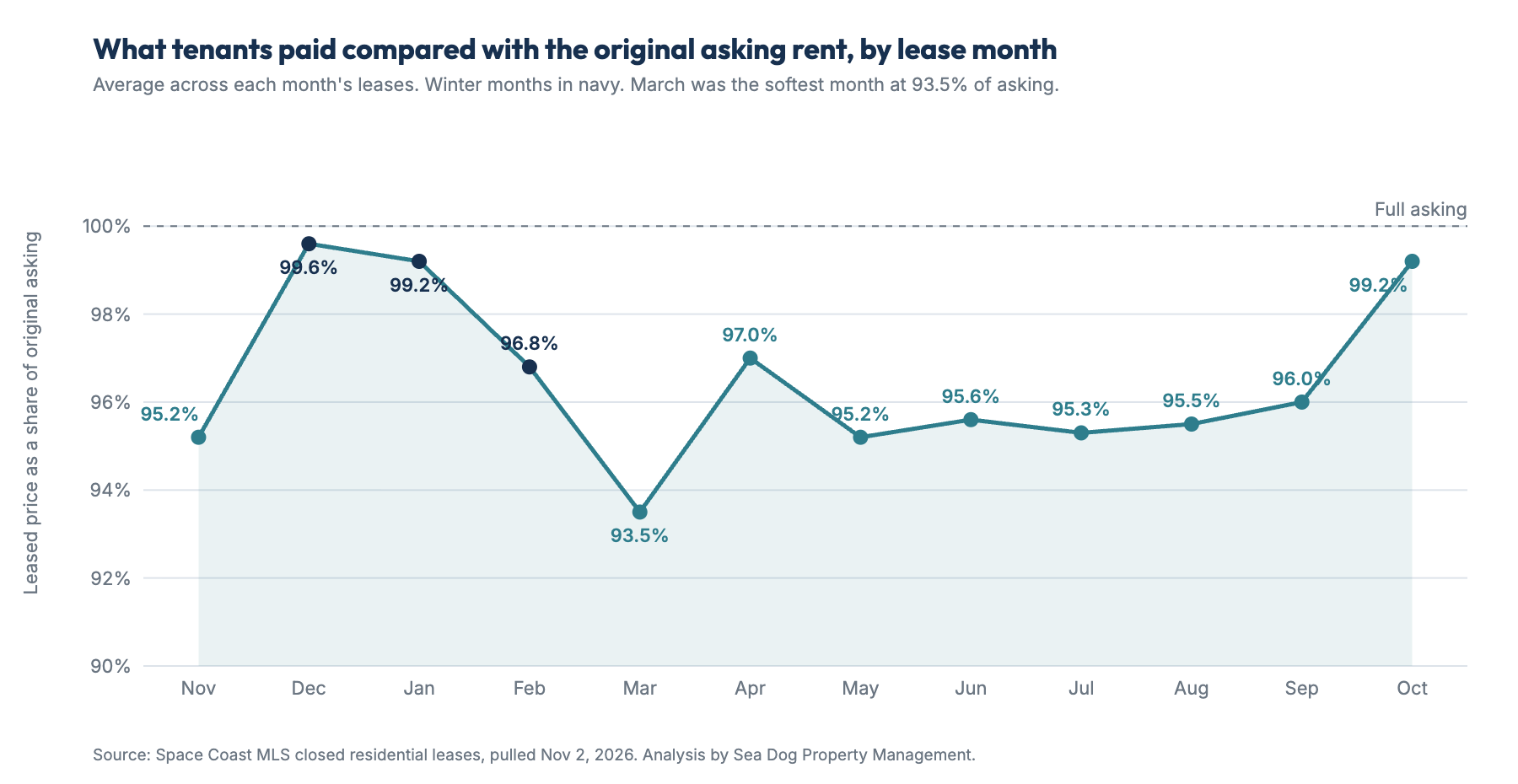
Why would the slow season hold price better? Our read is that winter listings are mostly the homes that were priced right from the start and simply waited for their tenant, while the homes that were overpriced in fall took their cuts and leased in March at a discount. The spring crowd also has more homes to choose from, which gives them room to negotiate.
On a $2,100 rental, three percentage points is about $65 a month, or $780 over a 12 month lease. The extra two weeks of winter vacancy costs about $1,050. Those two numbers nearly cancel, which leads to the practical rule.
Key point: A beachside rental that comes vacant in November or December should be priced from current comps and then held, not cut. Winter tenants paid closest to full asking all year. A rental that comes vacant in late February or March should expect to negotiate, because March tenants paid 6.5% below original asking on average, and holding firm into April is what pushed many of those listings past 90 days.
What a no pets rule really costs a beachside owner
Of the 638 leases, 533 had a pet policy recorded in the MLS. 321 said no pets, 212 allowed pets with some combination of deposits, weight limits and breed rules, and 57 said call the agent. The no pets group took a median of 63 days to lease. The pets allowed group took 45. That is an 18 day gap, and it is not a fluke of a few slow listings. 35% of no pets homes sat more than 90 days, against 22% of pet friendly homes.
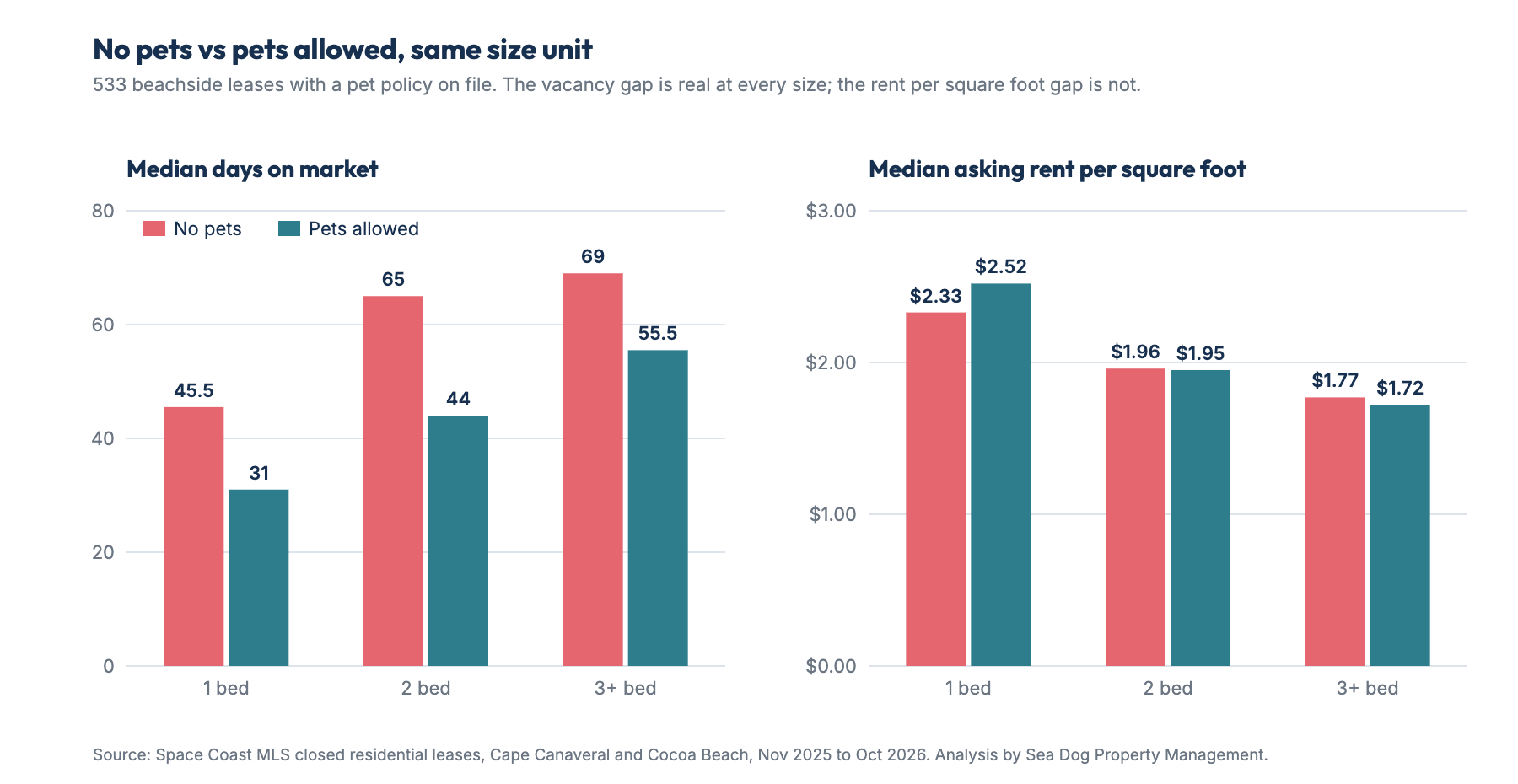
The gap holds at every size. Pet friendly one bedrooms leased in 31 days against 45 for no pets. Two bedrooms, 44 against 65. Three bedrooms and up, 55 against 69. The reason is simple arithmetic: the American Pet Products Association puts U.S. pet ownership at about two thirds of households, so a no pets listing starts by turning away most of the people searching. Those renters filter you out on Zillow before they ever see your photos.
The gap even survives the furnished question. Many beachside condos are furnished seasonal units that ban pets by association rule, and furnished units behave differently in every market. When we limited the comparison to unfurnished homes only, no pets listings still took 61 days against 42 for pet friendly homes.
Does banning pets at least protect the rent?
No. The raw numbers make it look that way, because no pets listings averaged $2.04 of asking rent per square foot against $1.96 for pet friendly listings. That difference disappears the moment you compare like with like. No pets units are smaller, with a median of 1,092 square feet against 1,288, and small units always rent for more per foot.
Bedroom for bedroom, asking rent per square foot was the same or slightly lower for no pets homes. Two bedroom no pets homes asked $1.96 a foot; two bedroom pet friendly homes asked $1.95. Among one bedrooms, the pet friendly homes actually asked more, $2.52 against $2.33. Pet friendly listings were also more likely to get what they asked for: 58% leased at full original asking, against 50% of no pets listings.
So the owner who bans pets gives up about 18 days of rent to protect a price advantage that does not exist. On a $2,100 rental, 18 days is about $1,260. A pet deposit, a monthly pet fee and a weight or breed limit kept most of the pet friendly homes in this sample in the fast group while still giving the owner something to cover wear. Our Pet Policy Checklist for Florida Landlords walks through those terms, and keep in mind that a no pets rule never applies to service animals or assistance animals, which we cover in this guide.
How to use this if your beachside rental is vacant right now
Start with the month. If the home is coming vacant between now and the end of December, price it from the active listings on your street, make sure the photos are strong because winter renters tour less and browse more, and give it the full eight to ten weeks before you treat the days on market as a price signal. The data says your tenant will pay close to full asking when they arrive.
If the home will be vacant in March, set the opening rent a little tighter and plan a weekly review from day one. The spring renter has more choices and will negotiate, and a listing that drifts into April at last fall's price is the one that ends up on the market 90 days.
Then look at the pet line. If the building allows pets and you have been saying no out of habit, reconsider. A dog deposit and a two pet limit cost you nothing on asking rent and historically cut vacancy by more than two weeks. If the association bans pets, you cannot change that, but you can price in the slower lease-up so it does not catch you by surprise.
One caution on the data. September and October 2026 show fewer leases in the chart because many leases signed in those months had not yet been marked closed in the MLS when we pulled the records on November 2. The day counts are real, but the volume is partial. The full spreadsheet of all 638 leases is available to any owner who wants to check our math.
Next step
If your Cape Canaveral or Cocoa Beach rental has been listed more than three weeks, or you are about to list one into the holiday season, a priority rental review looks at the asking rent against the active comps, the pet policy, the photos and the showing setup, and tells you which one is holding the home back. If you just want to know what the home should rent for before you decide anything, a free rental analysis gives you that number from current listings on your street.
Frequently asked questions
Should I lower the rent on my beachside rental if it has not leased by Christmas?
Not on the calendar alone. In the past year, leases signed in December through February in Cape Canaveral and Cocoa Beach took a median of 65 days to come together, so a home that has been listed six weeks in December is on pace, not behind. Those winter tenants also paid an average of 98.5% of the original asking rent, the best of any season. Cut the price if showings have stopped or if the active comps on your street have moved below you, not because the holidays feel slow.
How much does a no pets policy cost a Florida landlord?
In this sample of 533 beachside leases with a pet policy on file, no pets homes took a median of 63 days to lease and pet friendly homes took 45, a gap of about 18 days. On a $2,100 rental that is roughly $1,260 of lost rent per turnover. Asking rent per square foot was no higher for no pets homes once unit size was held equal, so the ban did not recover that cost. A pet deposit, a monthly pet fee and weight or breed limits are the usual middle ground.
Can I say no pets if my condo association bans them?
Yes, and you have no choice if the association's documents prohibit pets, since the tenant is bound by those rules through your lease. Build the slower lease-up into your vacancy budget instead. One thing the association cannot override is federal and Florida fair housing law on service animals and assistance animals, which are not pets. Our guide to service animals, ESAs and pets in Florida rentals covers how to handle those requests.
What is the best month to list a rental in Cape Canaveral or Cocoa Beach?
April was the fastest month in the past year, with a median of 34 days to lease and more than 60% of leases closing at full asking. May through August ran 44 to 56 days. If you can steer a lease end date, aim for the tenant's move-out to land in March or April so the home is on the market during the spring surge rather than in December, which was the slowest month at a 71 day median.
Already renting it out and not sure it is performing?
A Priority Rental Review looks at your rent, your lease and your expenses and tells you what to fix first.

Don Harkins
Broker and Owner, Sea Dog Property Management
Don Harkins is a licensed Florida real estate broker (CQ1068457) who has managed rental homes across Central Florida and the Space Coast for more than 13 years. He writes about the decisions that cost owners money and how to avoid them.
About Sea Dog