Who pays for the AC in a Florida rental, and how often to service it
The statute is silent on AC, so the lease controls. What Sea Dog leases ask of tenants, the twice-a-year service schedule, Florida humidity norms and 2026 replacement costs.
Don HarkinsPublished 7 min read
Key takeaways
- F.S. 83.51 lists heat, running water and hot water but never air conditioning, so the lease decides who pays
- Sea Dog leases put monthly filters and the vinegar drain flush on the tenant, and repairs, tune-ups and replacement on the owner
- Two professional visits a year, spring and fall, is the industry recommendation, and spring is the one that matters in Florida
- Orlando averages 88% morning humidity, which is why drain lines and float switches are the most common AC calls
- Budget $5,500 to $9,000 installed to replace a 3 to 4 ton system in 2026
In this article
- Does Florida law require me to provide air conditioning?
- Who pays for what in a typical Sea Dog lease?
- How often should a Florida air conditioner be serviced?
- What does Florida humidity do to the system?
- What does a replacement cost in 2026?
- What this means in Central Florida and on the Space Coast
- Next step
In nearly every Florida lease the owner pays to repair and replace the air conditioner, the tenant pays for filters and for damage caused by neglect, and the only way to know for certain is to read the lease. F.S. 83.51, the statute that lists what a landlord must maintain, does not mention air conditioning at all. That makes the lease, not the law, the document that decides who pays when the compressor dies in August, and it makes a service schedule the cheapest insurance you can buy against a $5,500 to $9,000 replacement.
Does Florida law require me to provide air conditioning?
Not by name. F.S. 83.51(1) requires a landlord to comply with applicable building, housing and health codes, or where none apply, to keep the roofs, windows, doors, floors, steps, porches, exterior walls, foundations and all other structural components in good repair and the plumbing in reasonable working condition, with screens installed at move-in. Subsection (2) adds, for units other than a single-family home or duplex, extermination, locks and keys, clean common areas, garbage removal, and functioning facilities for heat during winter, running water and hot water. Heat is on the list. Cooling is not. For a single-family home or duplex, the statute says the subsection (1) duties may be altered or modified in writing.
So the lease controls. Once your lease promises air conditioning, it becomes a material provision of the rental agreement, and F.S. 83.56(1) lets a tenant terminate if the landlord fails to fix a material provision within 7 days after written notice. A dead system in July, a written notice and a week of silence is how a good tenant walks away from a lease with no penalty. A local housing code that addresses cooling would apply through 83.51(1)(a), so ask your attorney about the county you own in.
Who pays for what in a typical Sea Dog lease?
Sea Dog's leases follow a simple split: the owner pays for the system, the tenant pays for the habits that keep it alive, and whoever's neglect causes a failure pays for that failure.
| Item | Owner | Tenant |
|---|---|---|
| Monthly air filter changes | Tenant buys and installs | |
| Thermostat batteries | Tenant | |
| Professional tune-up, twice a year | Owner, at vendor cost | |
| Drain-line flush and clearing | Owner, every six months | Tenant pours vinegar monthly once shown the cleanout |
| Repairs from normal wear (capacitor, contactor, fan motor) | Owner | |
| Repairs from neglect (coil frozen under a filter never changed, debris left against the condenser) | Billed back to the tenant | |
| Full system replacement | Owner |
The bill-back line matters more than it looks. F.S. 83.51(4) says the landlord is not responsible to the tenant for conditions created by the negligent or wrongful act of the tenant or the tenant's guests. A technician's note that the filter was black and the coil iced over is the evidence that moves a $300 repair from your statement to the tenant's ledger. That is why Sea Dog audits the filter at every visit, and why repairs under the owner's approval threshold, $400 by default, get handled without a phone call.
Key point: F.S. 83.51 lists heat, running water and hot water. It never says air conditioning. Whatever your lease says about the AC is the whole rule.
How often should a Florida air conditioner be serviced?
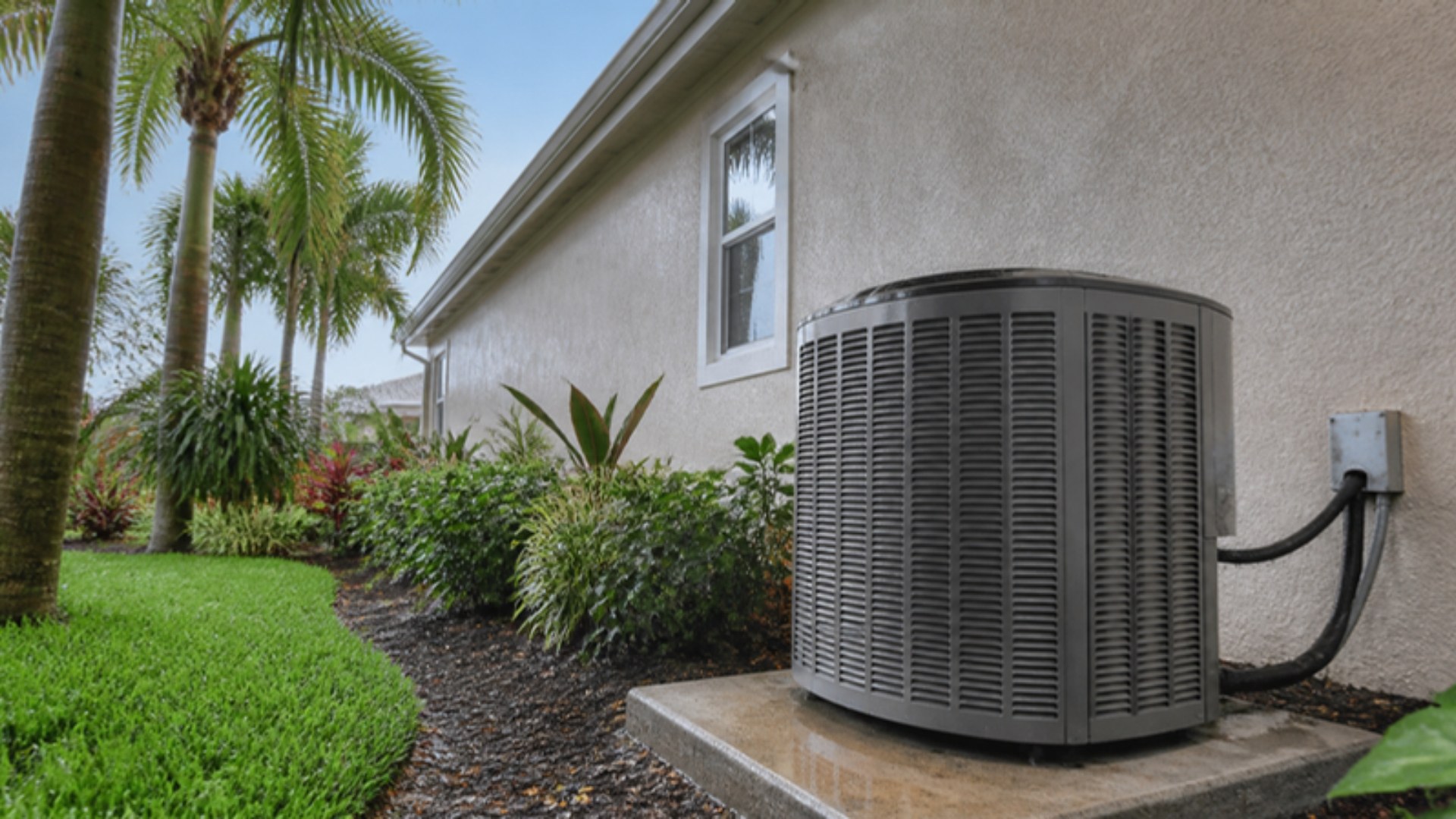
Twice a year is the common industry recommendation, once in spring before cooling season and once in fall, and in Florida the spring visit is the one that matters. The U.S. Department of Energy's maintenance guidance adds the owner-side basics: clean or replace the filter every month or two during the cooling season, more often with constant use or pets; check and clean the evaporator coil every year; keep debris away from the condenser and trim foliage back at least 2 feet; and pass a stiff wire through the condensate drain channels so the unit keeps removing humidity. A clean filter alone can lower the system's energy use by 5% to 15%, according to the same page.
A Florida rental schedule that works:
- March or April: professional inspection of refrigerant charge, electrical connections, capacitor, contactor, coil condition and the condensate line.
- Monthly, May through October: the tenant replaces the filter and pours a quarter cup of white vinegar into the drain-line cleanout.
- September or October: second professional visit, with a drain-line clearing and, on coastal homes, a coil rinse.
- Every visit: the technician photographs the filter and the drain pan so the condition record exists if a bill-back is ever needed.
A central system can reach 15 to 20 years with proper care, according to Sears Home Services, while a neglected one fails much sooner.
What does Florida humidity do to the system?
Humidity is the second job. An air conditioner cools, and it dehumidifies, and in Central Florida the second job never ends. The Florida Climate Center's normals put Orlando's annual average relative humidity at 88% in the morning and 55% in the afternoon, with August and September mornings at 91%; Vero Beach, the nearest coastal station to Brevard, averages 85% and 61%. Every gallon the system pulls from the air runs through a warm, dark PVC drain line, which is why algae clogs, float-switch trips and water under the air handler are the most common Florida AC calls. Sea Dog's mold protocol treats 60% indoor relative humidity as the line above which drywall, carpet and wood start growing things, and the same logic applies to a vacant home: leave the system running at a moderate setpoint between tenants rather than shutting it off to save on the power bill.
What does a replacement cost in 2026?
Plan on $5,500 to $9,000 installed for the 3 to 4 ton split systems that serve most Central Florida and Space Coast rentals. A 2026 Florida pricing guide published by Advantage HVAC lists a 2-ton system at $4,500 to $7,500, 3-ton at $5,500 to $9,000, 4-ton at $7,000 to $11,500 and 5-ton at $8,500 to $13,000, plus $1,500 to $3,000 for high-efficiency equipment above 18 SEER2, permit fees of about $150 to $300, and a $300 to $800 coastal premium for corrosion-resistant coatings and elevated mounting. Those are one contractor's published ranges and quotes vary, so treat them as a budget, not a bid.
Compare that against the cost of not replacing. Zillow's rent index puts Brevard at $1,887 and Orange County at $1,950 a month. A tenant who leaves after a summer of patched cooling costs you a turnover plus at least one vacant month, which is 8.3% of annual rent before make-ready and marketing. A system past 15 years that has needed two repairs in one season is usually cheaper to replace than to nurse.
What this means in Central Florida and on the Space Coast
Inland, the enemy is humidity and run time: 88% average morning humidity in Orlando means the drain line and the filter are the two parts most likely to fail, and both are tenant habits as much as owner equipment. On the coast, the enemy is salt. Sea Dog schedules coastal AC inspections twice a year in Cocoa Beach, Cape Canaveral, Merritt Island and Melbourne Beach because salt air corrodes condenser fins, copper lines and cabinets faster than inland, and asks coastal tenants to rinse the outdoor unit's exterior fins with low-pressure fresh water monthly. After a tropical storm in either region, an outdoor unit with debris, sand or standing water inside it stays off until a technician has looked at it. The post-storm checklist is in our hurricane prep post, and the tenant-facing steps for a system that is not cooling are in the air conditioner troubleshooting guide.
Next step
If you are not sure what your lease says about filters, drain lines or who pays after a frozen coil, a Priority Rental Review reads your lease and your property's service history and tells you where the gaps are before the next cooling season does. It takes one conversation, and you keep the findings whether or not you change anything.
Frequently asked questions
Can I make the tenant pay for AC repairs?
Only for repairs the tenant caused. F.S. 83.51(4) relieves the landlord of responsibility for conditions created by the tenant's negligence or wrongful act, so a coil that froze because the filter was never changed can be billed back if the lease assigns filters to the tenant and the technician documents it. Normal wear, such as a failed capacitor or a worn fan motor, stays with the owner under nearly every Florida lease. Write the split into the lease; do not assume it.
How often should AC filters be changed in a Florida rental?
Monthly during the cooling season, which in Central Florida runs roughly May through October, and every month or two the rest of the year. The U.S. Department of Energy recommends every month or two in cooling season and more often with constant use, dust or pets, and Florida systems run nearly constantly. Sea Dog's leases make filters a tenant responsibility, and the filter is checked at every visit.
Is a landlord required to fix the AC within a certain number of days in Florida?
No statute sets a number of days for air conditioning specifically. F.S. 83.56(1) lets a tenant terminate the lease if the landlord fails to fix a material provision of the rental agreement within 7 days after written notice, and if your lease promises AC, that clause applies. Sea Dog treats a summer outage as an emergency and dispatches a vendor within 2 hours, because the alternative is a vacant home in August.
Already renting it out and not sure it is performing?
A Priority Rental Review looks at your rent, your lease and your expenses and tells you what to fix first.

Don Harkins
Broker and Owner, Sea Dog Property Management
Don Harkins is a licensed Florida real estate broker (CQ1068457) who has managed rental homes across Central Florida and the Space Coast for more than 13 years. He writes about the decisions that cost owners money and how to avoid them.
About Sea Dog